


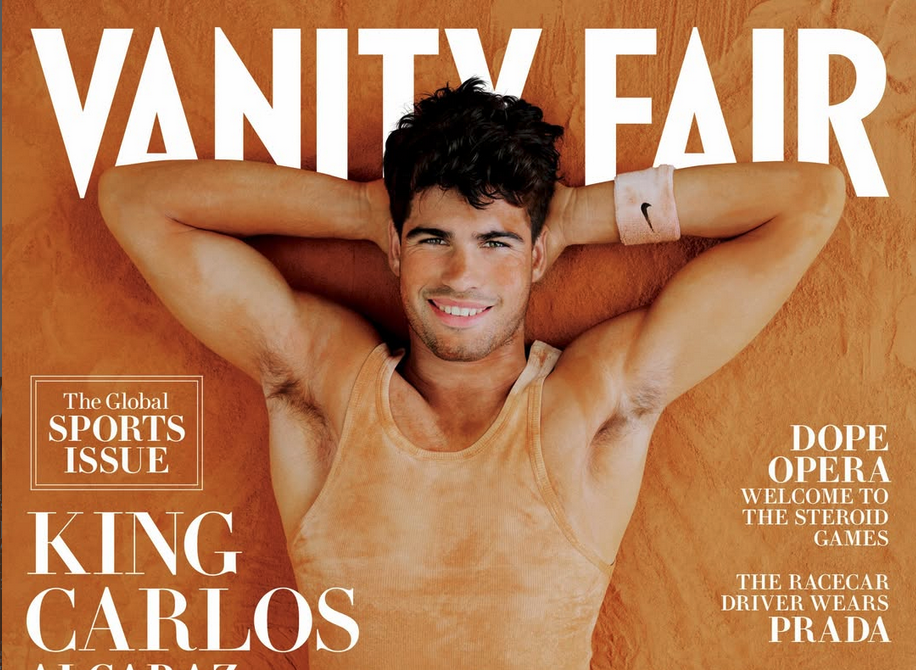
Spanish tennis sensation Carlos Alcaraz graces the May cover of Vanity Fair. As one of the brightest stars in men’s tennis, Alcaraz garners attention, whether he likes it or not. Journalist Jose Criales-Unsueita from the publication discusses Alcaraz's rise to number one and his rivalry with Jannik Sinner, which promises to define the future of the sport.
"I’m used to it," Alcaraz says with a disarming smile. "I’ve laid on the clay before, so it’s nothing new!"
We watch Alcaraz shuffle across the red clay, but not playing tennis. Instead, he’s posing for photos for Vanity Fair's cover shoot ahead of the Miami Open, where he faces his first match after turning 23 earlier that month.
Alcaraz is ready for anything. He’s known to be a true gentleman, cleaning courts after practice, greeting staff and fellow players warmly. His disarmingly polite demeanor surprises, given his energy and boldness on the court.
When he hears fans cheering, Alcaraz motions to his ear, encouraging them to cheer louder.
Alcaraz is energetically serving and moving confidently, his self-assuredness on the court well-deserved. On the day of our meeting, he is the world’s number one player, drawing celebrities to the stands as easily as he wins trophies: Spike Lee, Dua Lipa, David Beckham, Rory McIlroy. The list is long.
Together with Jannik Sinner, Alcaraz is half of “Sincares” – a moniker created by fans for their rivalry, described widely as a “rebirth” for tennis following the dominance of the "Big Three" era (Roger Federer, Rafael Nadal, and Novak Djokovic).
"I know I’m living a dream life, a life I’ve always dreamt of," Alcaraz says. "But sometimes I wish I had more moments for myself, to do things a 22-year-old man would do."
In person, Alcaraz is gentler than his on-court persona suggests. He is the biggest showman in men’s tennis and knows it.
In February, Alcaraz became the youngest man to win the Career Grand Slam. His opponent, Djokovic, praised the achievement: "What you’re doing, I think the best word to describe it is historic," the Serb said in a post-match interview.
When Alcaraz arrived for his first match in Miami, he wore a new Nike cap with the inscription "YOUNGEST EVER TO WIN THE 4 OF THEM." As often happens with what Alcaraz does, the cap sparked controversy. The key word, "man," was seemingly missing from the message, as noted by journalist Jose Murgado on X. But the back of the cap read "El más joven de la historia en ganar los 4 grandes" in Spanish, which is in the masculine gender. Whether this is a typical Alcaraz bold move or a simple translation issue remains a point of debate.
Skeptics wonder if his perceived immaturity affects his game. During a match in Miami against Sebastian Korda, Alcaraz approached his coach. "I can’t anymore. I can’t anymore, bitch, I want to quit, bitch," Alcaraz said in Spanish to his team. (In the previous month, at the start of the Monte Carlo Masters, Alcaraz stated he regretted these comments. The Spaniard lost to Sinner in the final in Monte Carlo, dropping to number two).
Alcaraz is fully aware that people will react. "It’s stressful because you constantly have to think about what you’re doing, when you’re doing it, and where you are," he says. "But as people, we have good and bad days, sometimes we wake up without the desire to do anything, but we still have to show up, and sometimes we don’t react as we should."
Despite this, Alcaraz is not perceived as a victim of his status. Instead, he is simply young, the youngest ever to achieve such success, but also just a young man in his early twenties.
"I don’t want to say it’s heady," he responds to a question about his numerous achievements.
"I’m aware that I still have a lot in front of me and try not to think about the 12 or 15 years I have left in my career because it makes me feel deflated," Alcaraz says with a laugh. What he doesn’t want is to lead a monotonous life that turns him into a "slave to tennis."
Alcaraz started his professional tennis career at 14 and broke into the top 100 of the rankings three years later. In 2022, he won the US Open and became the first member of his generation (the so-called "zoomers") to win a Grand Slam title and the youngest man to top the world rankings. His name is associated with many records that often start with "the youngest to ever...".
Alcaraz’s rivalry with Sinner is great for tennis and its fans, but he wants to manage expectations.
"Rivalries are long processes," Alcaraz says. "It’s not comparable to historical animosities in tennis because both of us have many years ahead. I hope we continue playing against each other many times, in many finals, and sharing the biggest tournaments."
Tennis has seen its share of sex symbols: Muhammad Ali, David Beckham, Cristiano Ronaldo, Tom Brady. But Alcaraz, a child of the internet age, has a unique grasp of how quickly an image can go viral. He is "Carlitos," who goes viral online with the same ease and speed as he hits a tennis ball. He has earned a permanent place in the social media feeds of anyone even remotely interested in tennis or men.
From the Australian Open alone: over 1.2 million views on TikTok for defending his opponent Alex de Minaur from a time violation warning; 3 million on Instagram for taking off his shirt after a match and winking at the camera after a burst of applause; 3 million on Instagram for a super compilation after his Melbourne victory; and 9.2 million on both platforms for his post-match "unplug" moment.
Alcaraz’s explosive nature is in contrast to many of his colleagues who appear overly serious and reserved. Whether he’s making deliberate shows or is a natural artist, he believes his showman spirit is an integral part of his game. "That’s how I play, that’s what I like, and that’s how I want to play," he says. "When people have fun, and I see they enjoy it, I enjoy it too."
Viral moments are good for his image and for the sport, but they can also be a downside. "Now anyone can easily leave a comment and hurt an athlete with just one comment," he acknowledges, admitting that negative comments sometimes impact his game.
Athletes like Alcaraz are not just focused on breaking records. "There are records I want and that I’m chasing, but they are for when I can look back at my career, and see what I’ve achieved and where I stand compared to others," he says. "But I have to admit, it’s nice to see your name in some places."
Djokovic has said Alcaraz combines "the best of the three worlds" – his own, Federer's, and Nadal's.
But Alcaraz states that he’s moved beyond simple comparisons. "We’ve reached a point where the comparisons have stopped," he says. He can appreciate a compliment like Djokovic’s. "It’s nice to hear it," he pauses, then smiles like a boy being praised by one of his idols: "It’s really cool." He regains his composure: "But I always strive for my own style, that’s what I’ve created and trained to perfect. I haven’t copied anyone. Now people know that I am Carlos Alcaraz."



Comments