


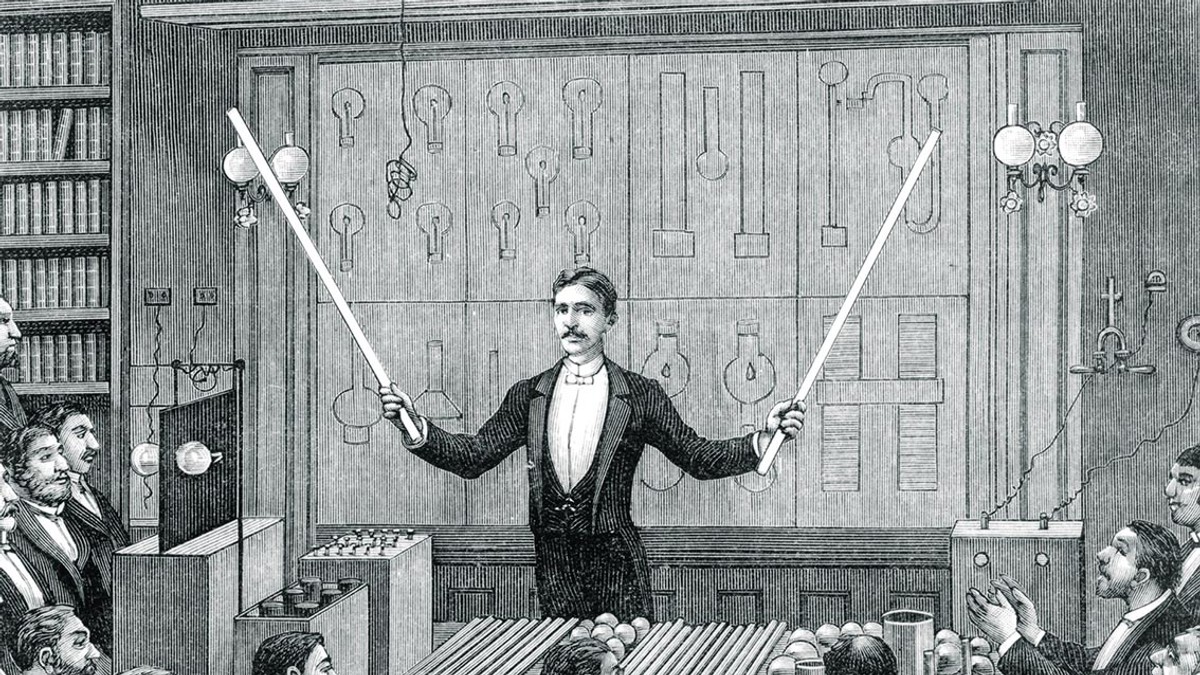
Serbian-American inventor Nikola Tesla (1856-1943) arrived in Belgrade on June 2, 1892, to receive the Order of St. Sava, Second Class. Witnesses from the time describe a grand reception at the railway station. He was received by the Minister of Education, Androm Mitrović, and met with King Alexander Obrenović. Tesla visited the National Museum and the Great School, where he spoke to students and professors about his work. He also discussed the construction of the first power plant in Belgrade with Serbian physicist Đorđe Stanojević.
Tesla's speech to the students was particularly memorable. He said, "As you can see and hear, I remain a Serb beyond the seas, where I engage in research. You should be the same and raise the glory of Serbia in the world with your knowledge and work."
A grand ceremony was held in honor of Tesla on Topčider Hill, near today's Mostarska Petlja. The famous Serbian poet and doctor Jovan Jovanović Zmaj greeted Tesla with a welcome poem. Tesla was a great admirer of Zmaj and translated his works into English.
Tesla was born on July 10, 1856, in Smiljan, Lika, which was then part of the border region of the Austrian Empire. His father was a Serbian Orthodox priest, and his mother came from a prominent priestly family. Tesla studied in Gospić, Karlovac, Grac, and Prague. He worked in Maribor, Pest, Strasbourg, and Paris before moving to the United States in 1884.
In 1884, Tesla joined Thomas Edison's company in New York, but he left after less than a year to found his own company, "Tesla," where he began developing models for alternating current, a revolutionary innovation. Tesla visited Europe twice from the United States, in 1889 and 1892, both times returning to his native Lika.
Tesla, a genius innovator and a confirmed recluse, died on January 7, 1943, in New York City during World War II. His ashes were moved to Belgrade and are now preserved in the Nikola Tesla Museum.

Tesla's visit to Belgrade was a pivotal moment for Serbian pride in science. But why hasn't Serbia produced another genius like Tesla? What's holding back the next generation of Serbian inventors?