


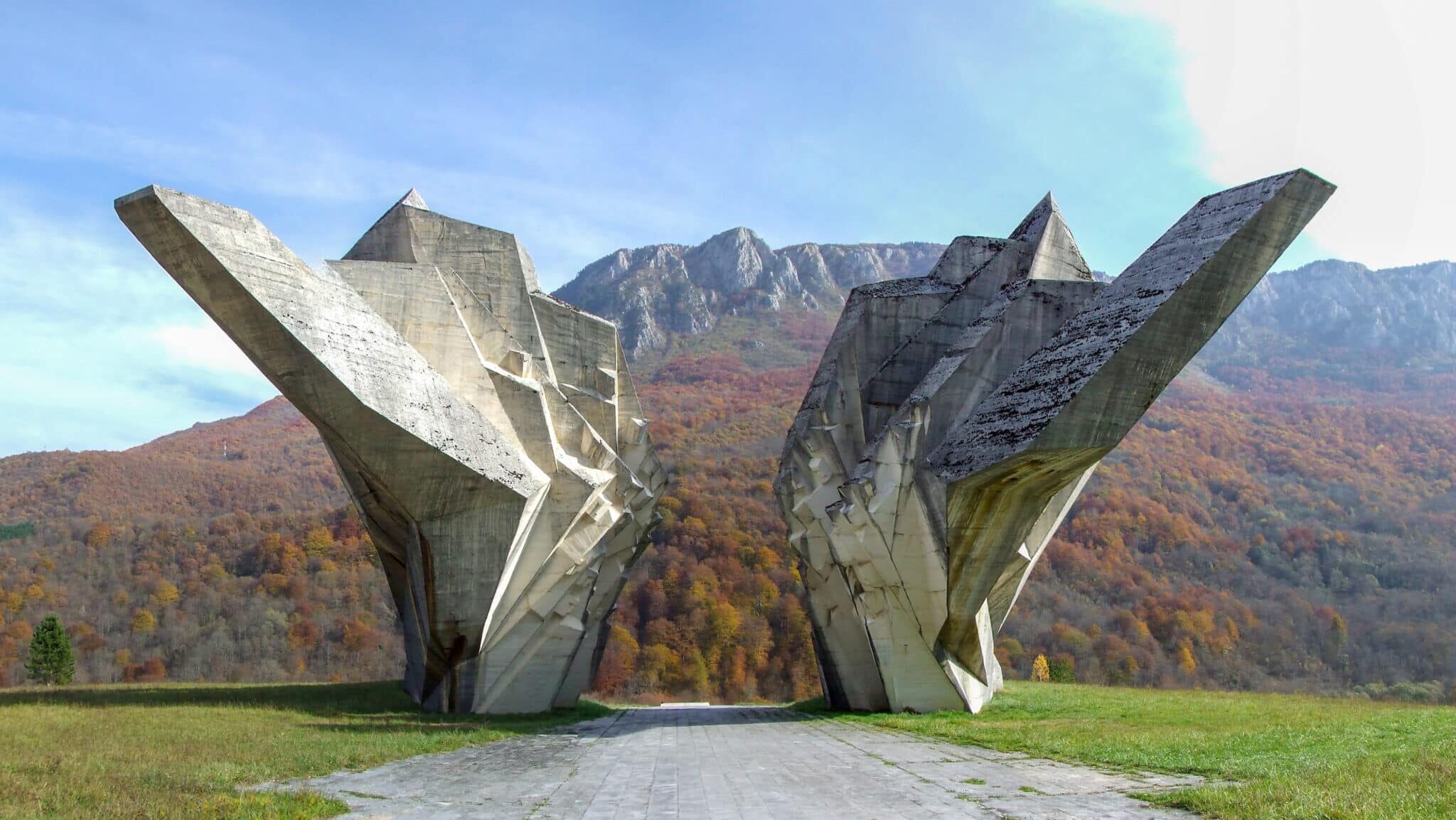
At the entrance to the Garavice Memorial Park near Bihac in Bosnia and Herzegovina, an inscription reads: “Life is stronger than death, justice is stronger than crime, love is stronger than hatred.” Behind it stands 13 stone monoliths up to six metres high, built in memory of Serbs and others massacred in the area in 1941 by Ustasha forces of the Independent State of Croatia (NDH), a Nazi puppet state. Designed by Yugoslav architect Bogdan Bogdanovic, the memorial was unveiled in 1981 and became part of the broader Yugoslav narrative of fascist terror and Yugoslav ‘Brotherhood and Unity’.
Historian Dino Dupanović, director of the Una-Sana Canton Museum, explains that after 1991, as Bosnia teetered on the brink of war, the 50th anniversary of the massacres took on a distinctly Serbian Orthodox tone and was organised by newly formed Serb national bodies. The memorial was assigned an entirely new political function, becoming a place where the narrative of Serbian endangerment and the need for ‘self-protection’ in the forthcoming war was constructed.
Bosniak and Croat communities in Bosnia began to do something similar, Bosniaks with the Kulen-Vakuf killings and Croats with the crimes committed in Krnjeusa, both in 1941. These processes, while an expression of long-standing sense of injustice, contributed to the fragmentation of the shared Yugoslav memorial matrix and opened the possibility for competing narratives of victimhood.
For decades, World War II occupied a central place in collective memory and public discourse across the territory of socialist Yugoslavia. Thousands of monuments mushroomed across the country, celebrating the National Liberation Struggle and honouring the victims of fascism. These monuments and official narratives constructed by the Yugoslav authorities held pronounced socio-political significance, fostering unity among the various peoples of Yugoslavia and central to the state’s ideological narrative.
But as the federation unravelled and nationalist parties came to power, the once dominant narrative acquired an additional dimension, becoming a tool of ethno-national politics aimed at mobilising and homogenising national groups and deepening interethnic divisions. Former symbols of anti-fascist struggle and unity were transformed into instruments of manipulation, historical revisionism, and political propaganda.
Memorials and memories of WWII, constructed over decades with the goal of preserving collective memory and unity, became arenas of division and conflict through which new nationalist symbolism was articulated. They became instruments for the legitimisation of the conflicts that followed. This was particularly evident in Bosnia, which endured three and a half years of war in the early 1990s. Today, the culture of memory remains extremely sensitive.

Comments