


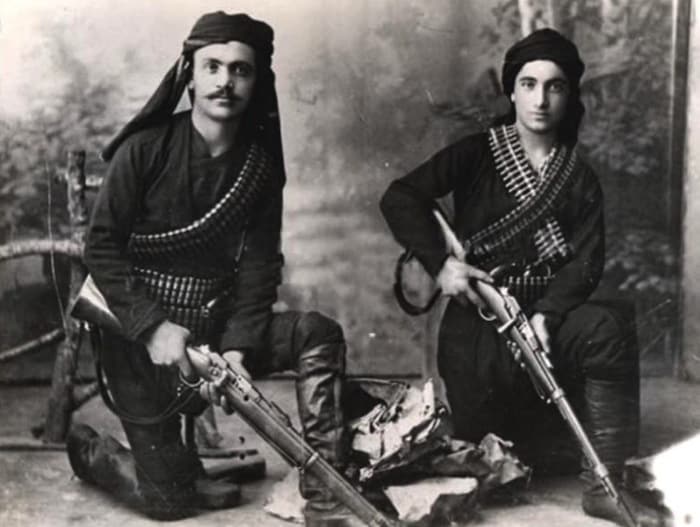
Between 1914 and 1923, the Ottoman Empire and Kemalist forces systematically exterminated approximately 353,000 Pontian Greeks. Facing forced deportations, labor battalions, and death marches, the Pontian Greeks formed resilient resistance networks, fighting courageously in the mountains to protect their families, villages, and culture from annihilation.
The story of Pontian Greeks is not only one of uprooting from their homeland of nearly 3,000 years but also of their brave resistance and guerrilla warfare. Greeks of Pontus who managed to escape labor battalions or direct extermination began to organize resistance against the genocidal Turks as early as 1915. The idea was not only to escape extermination and defend themselves but also to take revenge.
This is how the Pontian Greek guerrilla movement was created. Initially, a small number of Greeks climbed the Pontic mountains and resisted with primitive weapons, such as axes and pitchforks. With each new attack, guns were captured from the Turks. As Turkish attacks and massacres increased against civilians, small guerrilla groups began to be reinforced by people fleeing or wanting to avenge the slaughter of their relatives. The lawlessness and smuggling of weapons were widespread, helping the guerrillas acquire weapons.
There was no single national center to guide this whole movement, but the resisting Greeks of Pontus were greatly aided by the Metropolitan of Amasya, Germanos Karavangelis, who had guerrilla experience from the Macedonian Struggle a few years earlier. Soon, however, the leading figures of the Pontian Greek guerrillas emerged, including Charalambidis, Kontorakonidis, Tsaousidis, and Vassilios Anthopoulos.
Large areas of Pontus were dominated by Efkleidis Kourtidis, particularly the villages of Sanda (Σάντα, Turkish: Dumanlı). He fought hard to protect Greeks, and in one battle, had to make the heart-wrenching decision to kill seven children under his protection so the souls of another 300 Greeks could be saved. He and the Greeks of Sanda were some of the last to go to Greece after the population exchange began in 1923, arriving in Greece in 1924. His life came to a tragic end, especially for one with a great warrior reputation, as he fell out of his cart and was trampled on by his horses in 1934.
Another notable figure was Kotza Anastas (Anastasios Papadopoulos), known for his militancy and nicknamed "Kolokotronis of Pontus." His end was dramatic as he was betrayed for money after Turkish authorities put a bounty on him, resulting in his assassination by a relative who wanted the reward. Anastas is known for having escaped the brutal Turkish Labour/Death Battalions before joining Captain Yakov's (Iakovou Karatelidis) guerrilla group. He showed extraordinary bravery in battle and never lost a fight against the Kemalist Turks, continuing to fight bravely until his assassination in December 1922.
Many guerrillas took their families with them to the mountains, and the women helped the guerrillas in every possible way, mainly with delivering food and messages. They were very strong and husky women because they lived at high altitudes and ate very clean food. Many of the women also fought bravely, including Captain Eleni, who was "the last rebel" who fought in the mountains until 1924.


Comments