


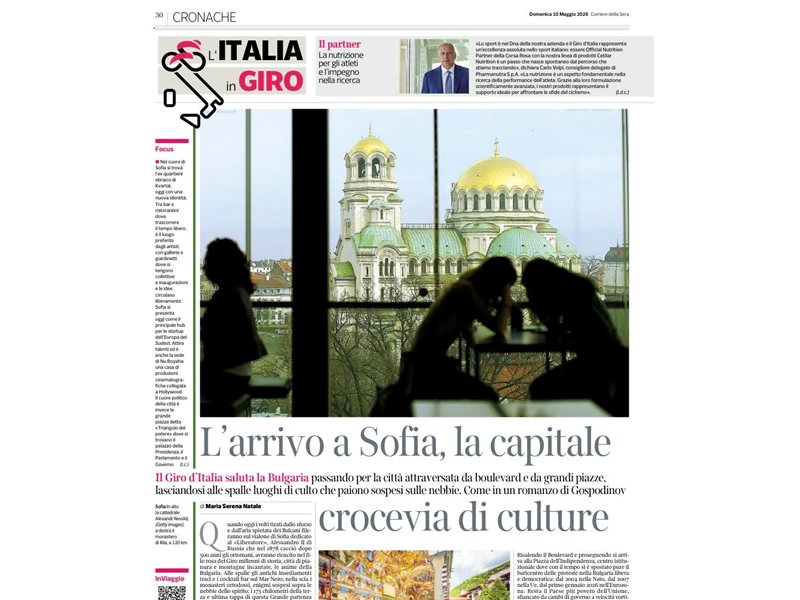
Italian daily Corriere della Sera presented the Giro d'Italia's start in Bulgaria as a narrative of the country's history, traumas, politics, and identity. Bulgaria, as portrayed, continues to exist between Europe and Russia, between past and future.
In her report, author Maria Serena Natali draws a literary picture of the country through which the Giro passes. "When the faces, worn out by effort and the merciless climate of the Balkans, pedal along Sofia's Boulevard, dedicated to 'Liberator' Alexander II," writes Corriere della Sera, "they will have traced the thousand-year history of Bulgaria in the pink thread of the Giro."
The main thread of the entire article is Bulgaria as a place where different times and worlds coexist simultaneously. The Italian journalist describes the country as a crossroads between antiquity and modernity. Behind the cyclists, the ancient Thracian settlements and cocktail bars by the Black Sea, the Orthodox monasteries, and enigmas looming over the mists of spirit remain.
The capital is portrayed as a city that "accumulates eras, styles, memories, and dominions," and which "willingly allows, at least for the duration of the competition, to be pulled out of the whirlwind of economic and political crises." The article makes a direct reference to Georgi Gospodinov's novel "Time Shelter" and the "clinic of science fiction where one can choose a decade of the 20th century best suited to one's inner rhythm." According to Corriere della Sera, Bulgaria itself is such a place, where the past never completely fades away.
The Boulevard "Czar Liberator," which the final stretch passes by, takes the competitors close to Sofia's iconic cathedral - St. Alexander Nevsky Cathedral. Dedicated to the Russian prince, military leader, and Orthodox saint from the 13th century, the cathedral is not only an architectural symbol but also a political sign. In the eyes of the Kremlin, Alexander Nevsky remains the embodiment of Russian glory and Orthodox power. For many Bulgarians, Russia continues to be the "liberator," despite the complex historical and geopolitical dependencies. The article highlights this special gratitude towards Moscow, which has never entirely disappeared from Bulgarian society.
The article also details the political unrest in contemporary Bulgaria. It recalls how, in September 1989, "tens of thousands gathered on the square in front of 'Alexander Nevsky' to demand democracy, inspired by the fall of the Berlin Wall." Just a day later, the "unthinkable" happened - the fall of Todor Zhivkov, "the man who embodied the most loyal Soviet satellite in the Eastern Bloc." The article mentions Zhivkov's attempt years earlier to convince the former Italian Communist Party leader Enrico Berlinguer to retract criticism of Soviet repression in Prague in 1968. "After the meeting in 1973, Berlinguer survived a mysterious assassination attempt on his way to Sofia airport - an episode that remains shrouded in doubt and political shadows."
The current political crisis in Bulgaria is described in detail. According to the Italian daily, Bulgaria remains "the poorest country in the EU," "exhausted by swift changes of government, corruption, and new candidates for perpetual leaders." The article mentions both Boyko Borisov, described as a "former karate instructor and former bodyguard to Zhivkov," and Rumen Radev. Radev, a former Air Force general, president, and politician with openly pro-Russian positions, has created a new populist left-wing movement that won an absolute majority in record time. The article states, "Growing concerns in Europe are that Bulgaria could become a new center of Euroscepticism and pro-Russian influence, a unique Balkan Orban model."
Comments