


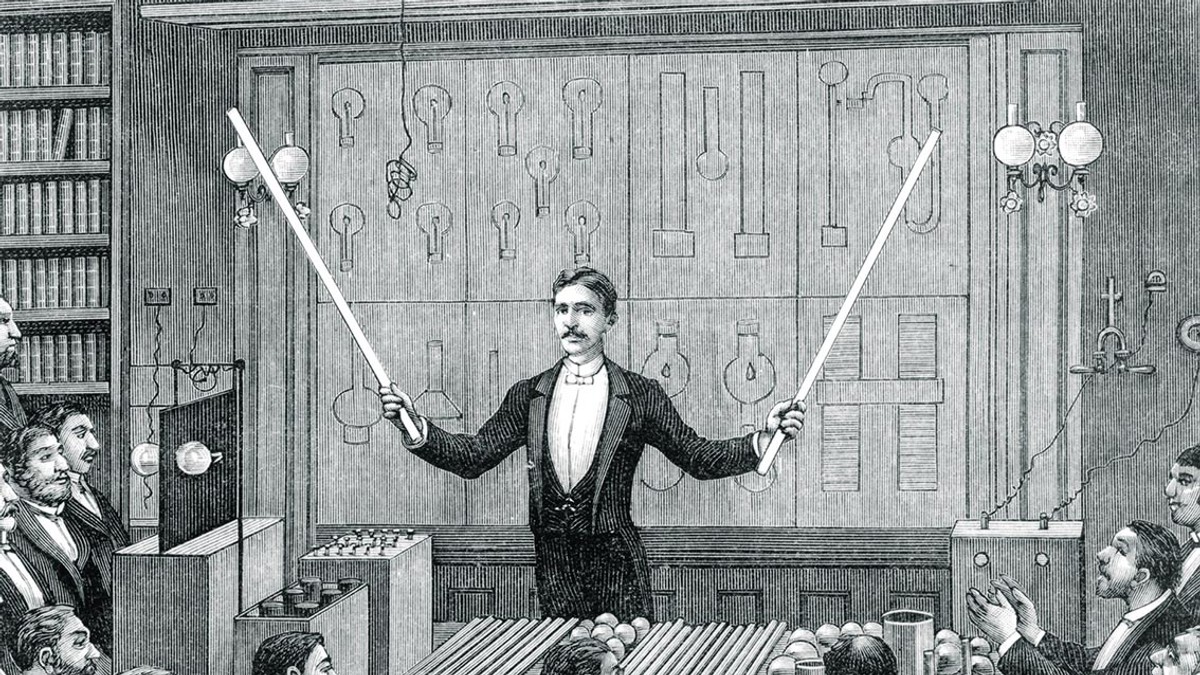
Nikola Tesla, celebrated Serbian and world scientist, arrived in Belgrade on June 2, 1892, where he was honored with the Order of Saint Sava, Second Class. Accounts from that period describe a grand reception he received at the train station. Tesla was met by the then Minister of Education, Androm Mitrović, and introduced to King Alexander Obrenović. He visited the National Museum and the Great School, where he spoke about his work to students and professors. Additionally, he discussed the construction of the first electric power plant in Belgrade with Serbian physicist Đorđe Stanojević.
In his famous speech, Tesla told the students, "I have remained a Serb, even across the oceans, where I conduct my research. You should do the same, elevating Serbian glory with your knowledge and work."
A grand event in his honor was held on Topčidersko brdo, near today's Mostarska petlja, likely at a villa near Vajfert's brewery.
The renowned Serbian poet and physician Jovan Jovanović Zmaj greeted Tesla with a welcome poem. Tesla greatly admired Zmaj and translated his works into English.
Born on July 10, 1856, in Smiljan, Lika, then part of the Austrian military border, Tesla came from a family of Serbian Orthodox priests. He started schooling in his hometown, continued in Gospić and Karlovac, studied in Graz and Prague, and worked in Maribor, Pest, Strasbourg, and Paris before moving to the United States in 1884.
He stayed in Edison's company for less than a year, then founded his own company, "Tesla," in 1885, beginning the creation of models for alternating current technology. In the 1890s, he returned to Europe, spending time in his native Lika. He visited Belgrade on the invitation of a delegation from the City of Belgrade and the Engineers' Association.
Tesla, a brilliant innovator and dedicated loner, died in New York City on January 7, 1943, during World War II. His urn was transferred to Belgrade and is now preserved in the Nikola Tesla Museum.
This is a reminder of Tesla's immense contributions and his deep connection to Serbia! How do you think his legacy has impacted the region's technological advancements?