


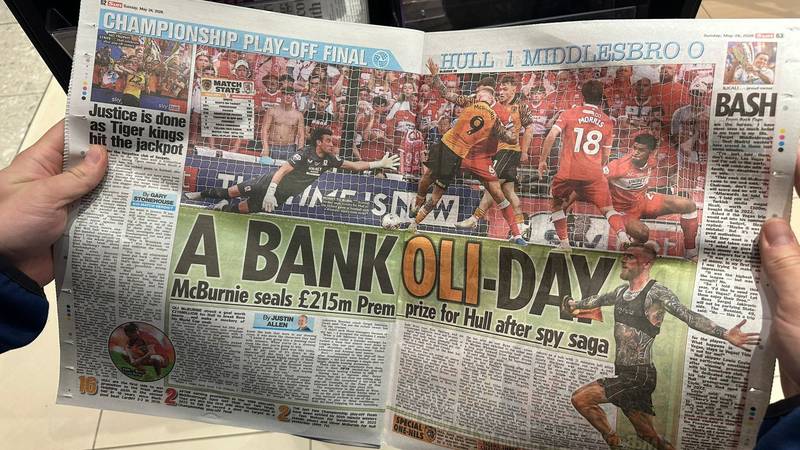
Hull City has returned to the Premier League after a nine-year absence, capping one of the most remarkable campaigns in recent English football history. At the center of this resurgence stands Sergej Jakirovic, a Serbian manager who has transformed his reputation from a figure of past controversies to a celebrated tactical pragmatist. The Tigers secured promotion by overcoming Middlesbrough at Wembley Stadium, completing a playoff run that defied advanced metrics, historical trends, and a season plagued by external disruptions.
Defying the Numbers
Advanced statistics suggested a relegation battle rather than a title charge. Hull conceded 66 goals during the regular Championship campaign, a defensive record worse than Oxford United, who ultimately dropped to League One. Expected goals models projected the Tigers to finish second from bottom. Instead, they secured sixth place and navigated the playoff bracket with clinical efficiency. After dispatching Millwall, they faced Middlesbrough in London. The match was a masterclass in defensive organization. Middlesbrough controlled possession and circulated the ball around Hull’s compact block, yet they failed to register a single shot on target. This tactical discipline allowed Hull to become the first sixth-placed side to earn promotion since 2010, a statistical anomaly that caught the attention of major British outlets.
A Season of Drama and Pragmatism
The road to London was anything but straightforward. The campaign began with the lingering threat of a transfer embargo and barely avoided a double relegation drop the previous season. The playoffs themselves were overshadowed by the Southampton FC espionage scandal, which forced a reshuffle of the final bracket and handed Middlesbrough a direct path to London despite a semifinal defeat. Hull owner Acun Ilcali publicly threatened legal action if the fixture proceeded, forcing Jakirovic to adjust his preparation on short notice. The manager handled the chaos with characteristic humor, dismissing the spygate controversy as a situation that would likely have been laughed off in the Balkans. On the pitch, his squad delivered exactly what was required. The pragmatic approach neutralized Middlesbrough’s attacking threats and secured the trophy. Following the final whistle, the players were rewarded with a celebratory trip to Las Vegas, marking the end of a grueling but ultimately successful season.
From Disgrace to Triumph
Jakirovic’s journey in English football has been defined by stark contrasts. British supporters largely remembered him from his time at Dinamo Zagreb, where his team suffered a historic 9-2 defeat to Bayern Munich in the Champions League. That result overshadowed his subsequent managerial career for years. This season, however, has completely rewritten that narrative. Major publications have praised his ability to manage expectations and extract maximum performance from a squad that statistically should not have advanced. The Sun highlighted his miracle-worker status, while Sky Sports emphasized how Hull’s campaign challenged conventional football logic. Guardian analysts focused on the defensive resilience displayed in the final, noting how tactical discipline outweighed statistical probability. For Jakirovic and his players, the promotion represents more than a return to the top flight. It is a validation of a resilient philosophy built on organization, adaptability, and mental fortitude. The Tigers now prepare for the physical and tactical demands of the Premier League, carrying the momentum of a season that refused to follow the script.



Comments