


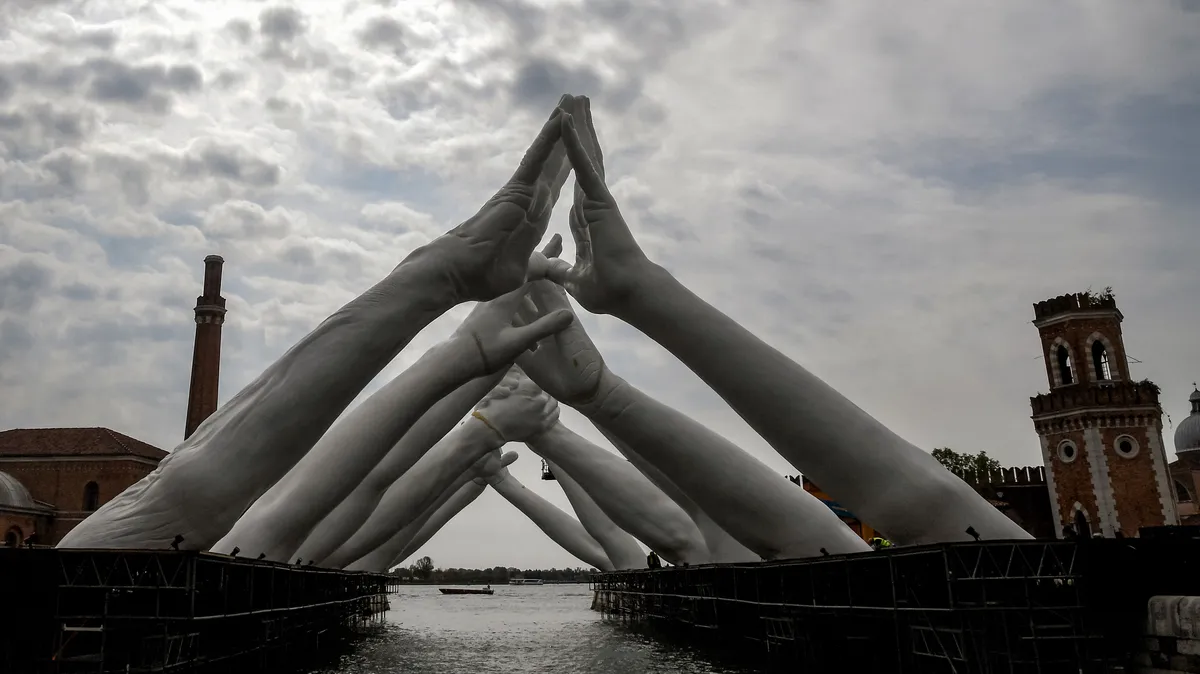
In the gardens where the largest contemporary art event was opened to the public on Saturday, the Russian pavilion is situated just a few steps from a deer sculpture salvaged from the Ukrainian front lines. This year's 61st Biennale has seen the return of Russia, which had been absent since its invasion of Ukraine in February 2022, alongside Israel, Palestine, and Ukraine. This presence has sparked controversy and disagreement within the international art community.
"Inviting them here to the Biennale is like inviting a serial killer to a dinner party," commented Ukrainian Minister of Culture Tetjana Berejna during the opening in Venice.
Berejna also stated that Russia has killed 346 Ukrainian artists since the start of the war, emphasizing that the war has targeted cultural institutions such as libraries, museums, and bookstores. She argued that the war aims to destroy cultural heritage, making the Biennale's inclusion of Russia particularly contentious.
In addition to Russia and Ukraine, other countries involved in global conflicts, such as the United States and Israel, are also participating. Iran, which was initially scheduled to participate, withdrew at the last minute. Israel has its pavilion located in the Arsenal, a former shipyard used as an additional exhibition space, close to the Ukrainian pavilion.
The Palestinian presence is marked by an exhibition titled "Gaza - Without Words - See the Exhibition" in Palazzo Mora. The exhibition curator, Faisal Saleh, emphasized the difficulty in describing the horror inflicted on Palestinians in Gaza. "There is no way to describe the horror that has been inflicted on Palestinians in Gaza, and we do not wish to be in the same space as those who have done it," he said.
The presence of Russian, Israeli, and American pavilions is accompanied by police stationed nearby, reflecting the geopolitical tensions that have spilled over into the art world. These tensions were further highlighted by a protest involving around 2000 people against Israel's presence at the Biennale.
The Biennale's director Pietrangelo Buttafuoco defended the inclusion of all participating countries, stating that the Biennale is meant to be a space where the world comes together, especially when it is falling apart. However, the controversy has led to the resignation of the entire jury and the cancellation of the Golden Lion award this year. The awards will now be decided by public vote.
National pavilions in Palazzo Mora remained closed on the opening day as staff refused to work in protest against Israel's participation. The Biennale remains a hotbed of political and cultural tensions, highlighting the complex intersection of art and global conflicts.
Comments