


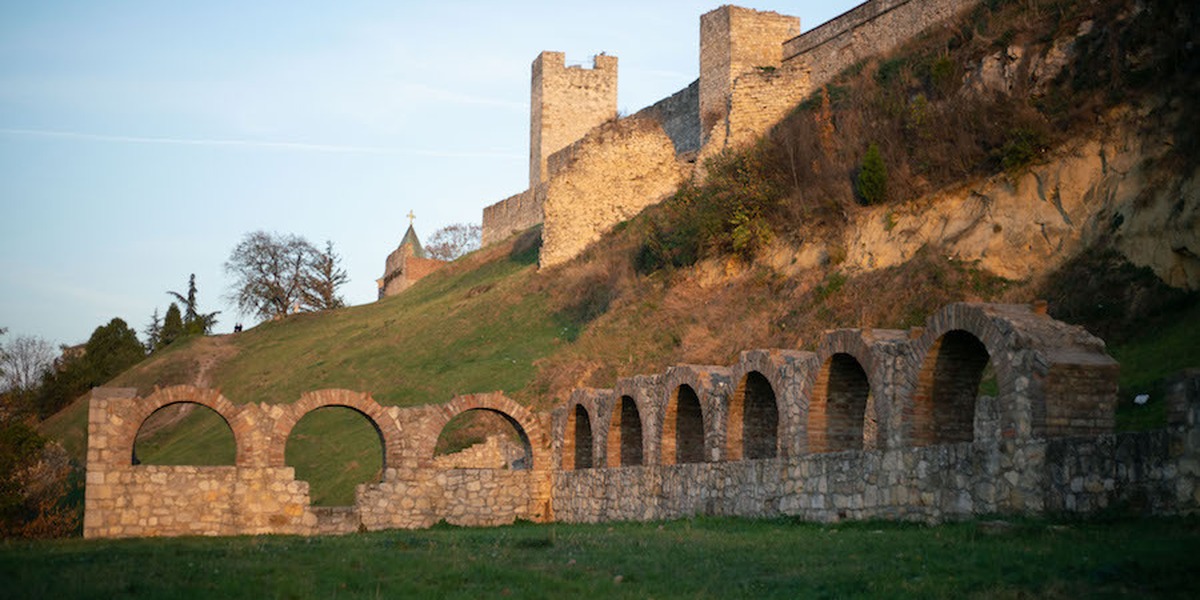
In the heart of Belgrade, on the grounds of the Donji Grad of Belgrade Fortress, which attracts about two million visitors annually, lie the remains of a once-metropolitan complex and a medieval cathedral. This site is one of the most important cultural and historical landmarks of the Serbian state. While most visitors are familiar with the Roman Well, Clock Tower, and Nebojša Tower, the ruins of the Metropolitan Palace and the site of the Assumption Church are less known, despite their significant historical value.
Historical Background
The remains of the Metropolitan Palace were discovered during archaeological excavations in 1977, when a search was launched for the main Orthodox church of medieval Belgrade. The excavations revealed that the church was located on an elevation above the Donji Grad of Kalemegdan. During these excavations, a portion of a marble portal with an inscription by Despot Stefan Lazarević was found.
While the exact date of the church's construction is unknown, historical sources note that Queen Simonida visited this sanctuary in 1315 to pay homage to a miraculous icon of the Virgin Mary. Danilo II described it as a large cathedral during the time of King Dragutin, likely a three-nave structure with a large dome.
Recent Discoveries
Archaeological research conducted in 1985 confirmed that the palace was part of the Metropolitan Palace complex and was destroyed by fire during the Turkish conquest of Belgrade in 1521. The partially reconstructed building today represents the oldest preserved medieval structure in Belgrade. The cathedral was later converted into a mosque by Sultan Suleiman, and during the Austro-Turkish wars in the 18th century, it was completely destroyed.
Historical records indicate that numerous relics and shrines were preserved in this complex, including the relics of Saint Petka and Saint Empress Theophano, and a reliquary with the hand of Saint Emperor Constantine, which is now housed in the Kremlin's treasury in Moscow.
The Assumption Church, which for centuries safeguarded the most important shrines of medieval Belgrade, gathered the people and served as the spiritual center of the city. The restoration of this site would be a long-overdue recognition of history, faith, and heritage that has nearly been erased by wars and destruction.
Author: Stefan Bogdanović

neki ne znaju da ovo postoji... sad treba da se opremi i postane atrakcija za turiste, nije li tako?