


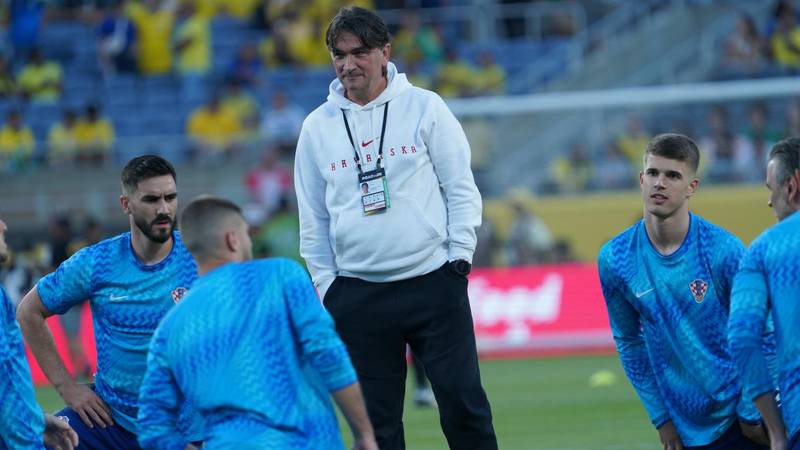
Zlatko Dalic has remained true to his principles. His team list is not just a snapshot of current form but a combination of cycles, merits, trust, and the ability to withstand tournament pressure. “The team is not just about current form. I look at a specific cycle and not everything is in form. I’ve been here for nine years and know what I’m doing. I stick to my principles and way of thinking and do not give up on that,” Dalic said when announcing the list of 26 players for the World Cup in North America.
Dalic’s list is a reflection of his commitment to his methods. His list is not just a snapshot of current form but a combination of a whole cycle, hierarchy, trust, and a long-term image he has built as the most successful manager in Croatian football history.
The most credit, as expected, goes to the core of the team. Luka Modrić, Mateo Kovačić, and Joško Gvardiol are key names in the structure of the "Croatians," but they are also three of Dalic’s biggest concerns heading into the World Cup. Not because of their quality, status, or experience, but due to injuries and a lack of continuity in their club teams.
Modrić, the captain, ended April with a double fracture of the toe bone but has still accumulated over 2700 minutes in 36 games this season for Milan. The bigger problem seems to be his main partner in the midfield, Kovačić, who has only played seven games for Manchester City this season due to a foot injury. After returning from injury in April, he has only played 118 minutes.
Gvardiol is in a similar situation, having returned against Crystal Palace last Wednesday. At 24 years old, Gvardiol will be playing his fourth major tournament with Croatia, making him the eighth most experienced player on Dalic’s list with 46 appearances.
Dalic has already tested a three-man defense system two years ago, but this time the circumstances are different. Croatia no longer has the same structure as in Russia or Qatar, lacking natural width on the wings. The most populated zone for the team, behind the midfield line, is the central area.
“We tried two systems in friendly matches. We will adapt to opponents and now have a mix of experienced and young defenders who can play in multiple formations. This is a tournament where we must be good in the defensive phase and we will try to play defense as best we can. I said I would not change the system, but with new players, I had to adapt and change based on their playing styles,” Dalic said.
Dalic is aware of the strengths and weaknesses of this squad, which must find width without traditional wing-backs and serve the attack from a different structure. His list may not excite everyone, but it is consistent. And for Dalic, consistency has always been both his greatest strength and risk. In Russia and Qatar, it brought him medals. North America will show if the same principle can withstand the generational change, injuries, and a tournament that starts against England.
Dalic's approach is solid but the generational shift and injuries are huge risks. Can he pull off another miracle in North America? Let’s see if consistency pays off once again!